
Please Read.
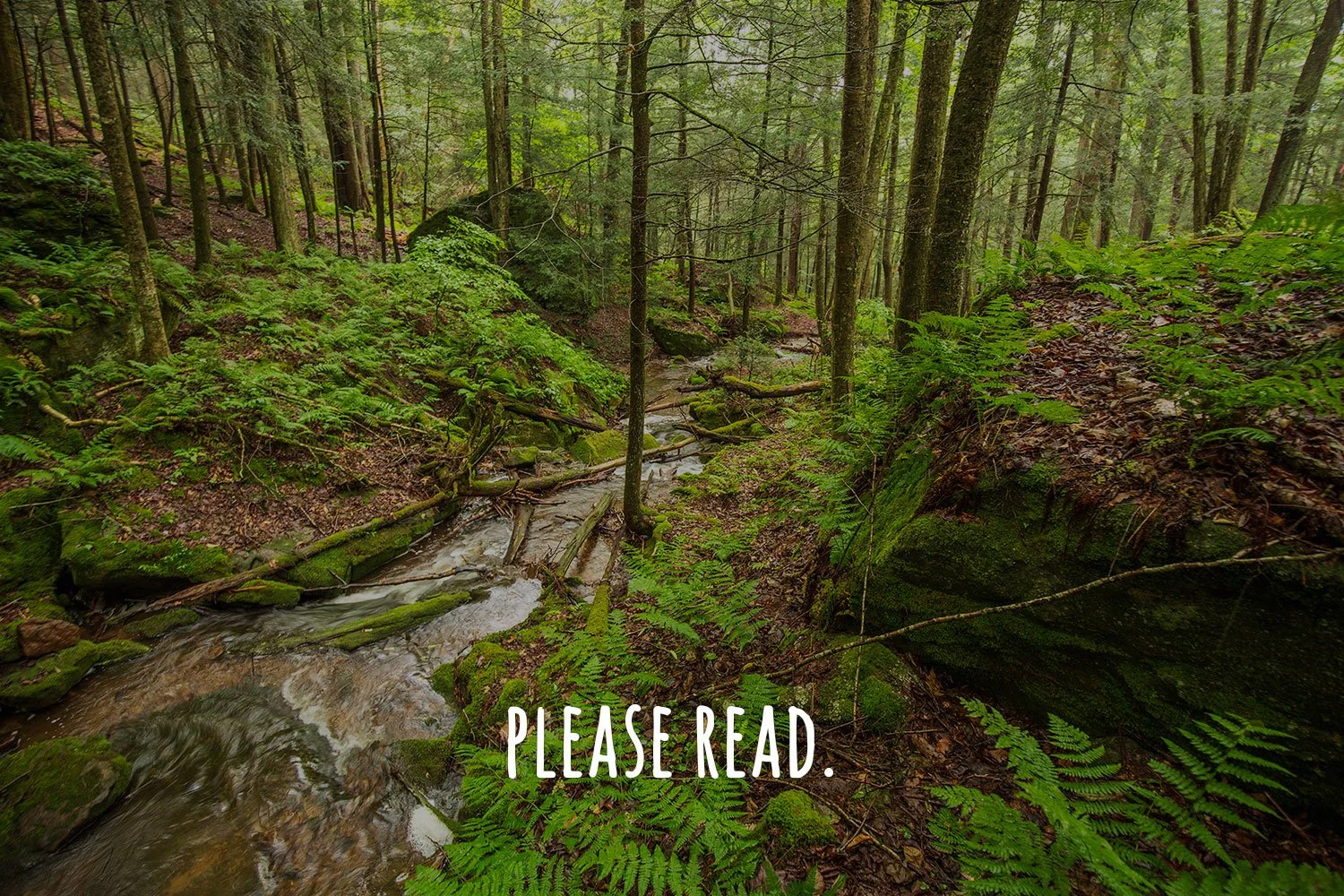
Tanbark Trail, Boardinghouse Run, Allegheny National Forest.
Friends, this is a long read with a call to action. As you probably know, the U.S. Forest Service announced a major reorganization on April 3, 2026, that includes the closure of 57 of its 77 research facilities across 31 states. The Forestry Sciences Laboratory here in Irvine, PA was one of them.
To better understand what this closure means for forest health in Pennsylvania’s only National Forest, we spent some time with a Research Forester who also served as Project Leader of the team of scientists, technicians, and administrative support personnel at the Irvine Lab. She has dedicated 36 years of her life to research in the Allegheny National Forest region at the US Forest Service, widely respected for bridging the gap between academic research and on-the-ground forestry.
A couple important things of note before we get into what impact this may have:
The scope of work within the Irvine Lab operates at many scales: individual trees, forest stands, and entire landscapes.
You may have seen the small Forestry Sciences building tucked away in Irvine near Buckaloons campground, but there’s a living laboratory as well, called the Kane Experimental Forest. Major research areas in this space include forest regeneration and succession; timber yield and stand development; wildlife habitat relationships; and carbon sequestration and nutrient cycling.
Also important to note, early federal forestry leaders strongly advocated for an independent research function, recognizing that science-based management would be essential to the agency’s long-term effectiveness. Accordingly, scientists working in the nation’s forestry research laboratories do not report to local forest supervisors. Instead, they report through the Research and Development branch to the Deputy Chief, and ultimately to the Chief of the U.S. Forest Service. This structure is intentional, ensuring that research remains objective and insulated from short-term operational pressures, and that management decisions are guided by the long-term health and sustainability of forest ecosystems rather than immediate or expedient solutions.
So, what are we potentially losing with the closure of the Irvine Forestry Sciences Lab?
We are not just losing a facility, we are potentially losing a foundation of science-based knowledge, continuity, and informed forest stewardship that has taken decades to build.
Long-term research:
Repeated measurements:
Nearly a century of repeated measurements at Hearts Content, Tionesta Scenic and Research Natural Area, and the Little Arnot plot provides an irreplaceable record of how forests change over time. These long-term records help us understand how forests change naturally, how they change when we manage them, and how to manage them in a way that sustains their health and their ability to meet our needs.
Precipitation data:
Weekly precipitation chemistry data has been collected every Tuesday since 1978 at the Kane Experimental Forest, through the National Acid Precipitation Assessment Program. The data has been used to track precipitation chemistry, including acidity, nutrients, and sulfate/nitrate concentrations, to study the effects of pollutants on forested ecosystems. Losing consistency in this record would weaken our ability to track long-term environmental change, including acid deposition and its ecological effects.
Research continuity:
Long-term research teams develop consistent methods for measuring forest composition, structure, and health, and deep familiarity with forest systems. This continuity allows scientists to revisit existing data to answer new questions—such as when the Irvine team linked black cherry seedling growth declines to changes in acid deposition in the mid-1990s. Without these teams, both methodological consistency and institutional knowledge are at risk.
Research data archives:
The lab houses extensive written and digitized records from decades of research. These archives are essential for ongoing and future studies. Without active stewardship, there is a risk that valuable data could become fragmented, inaccessible, or lost.
Science-based forest management in the region:
Knowledge transfer and collaboration:
Annual training sessions have brought scientists and forest managers together to share the latest research and its practical applications. These relationships ensure that management decisions are grounded in the best available science and that research remains relevant to real-world challenges.
Deer and forest management research:
Internationally recognized studies on the relationship between deer populations and forest management that helped heal Pennsylvania forests after nearly 50 years of deer overabundance. Long-term measurements, such as those from the Kinzua Quality Deer Cooperative, represent the world’s longest continuous record of forest recovery from deer overabundance.
Support for forest certification:
Public and private organizations rely on Irvine’s research to demonstrate responsible forest stewardship. Entities such as the Pennsylvania Bureau of Forestry and Forest Investment Associates depend on this science to meet certification standards and maintain credibility in sustainable forest management.
Decision-support tools:
The development of SILVAH has provided forest managers with a powerful tool to analyze data and link it to research results that aid in choosing forest management strategies. Irvine-based research expanded its capabilities beyond cherry-maple systems to include oak forests, increasing its relevance across the region.
The closure of the Irvine lab threatens the loss of long-term perspective, scientific continuity, and the direct link between research and on-the-ground forest management. These are not easily replaced. Without them, our ability to understand, sustain, and responsibly manage forest ecosystems for future generations is significantly diminished.
Instead of asking, “What should we do after we cut?” data-driven research shifted the question to, “Is this forest ready to be cut?” Foresters now measure advance regeneration before harvest, use systems like SILVAH to assess readiness, and delay or modify harvests if conditions aren’t right. This prevents failed regeneration, maintains desired species composition, supports wildlife habitat and diversity, and ensures forests remain productive for future generations. In its simplest terms, you can’t manage the future forest if you don’t understand what’s already growing beneath your feet.
The Forest Service’s research enterprise is the largest forestry research organization in the world. It has published nearly 60,000 peer-reviewed documents. Its experimental forests, some over a century old, provide irreplaceable long-term data on forest health, fire behavior, watershed function, and climate adaptation. The proposed restructuring of the Forest Service includes closure of at least 57 of 77 research locations. Almost every one of these can tell a story like the one at our Lab in Irvine.
We are deeply concerned. On a local and national level. USFS scientists study wildfire behavior, invasive pests, tree diseases, watershed health, and the impacts of climate change. That research doesn’t just sit on shelves, it goes directly into how forests are managed, how fires are predicted and fought, and how risks are mitigated before they become crises. Without agency scientists, these threats don’t go away, they become less visible and more dangerous. It is critical that there are individuals dedicated to observing and evaluating changes in forest ecosystems from a broad, long-term, data-based, strategic perspective.
We understand the Allegheny National Forest is, and always has been, a working forest. However, sound science is essential, not only for us today, but for the generations who will one day explore and seek to understand our river and forest long after we are gone.
How can you help? Please contact your elected officials. Speaking with a staffer is one of the most powerful ways to influence the vote. We’ve included key talking points and a basic phone script below.
Core message (opening statement)
- I am deeply concerned about the proposed closure of U.S. Forest Service forestry research laboratories.
- These labs are not just facilities; they are long-term scientific infrastructure essential to understanding and managing forest ecosystems.
- Closing them would permanently weaken our ability to make informed, science-based decisions about public lands.
Why continuity is critical
- Forest science depends on consistency in methods, locations, and research teams over time.
- When experienced research teams are dissolved, we lose not only data collection but also institutional knowledge that helps interpret decades of results.
- Interrupting long-term studies means losing the ability to detect slow, cumulative changes in ecosystems.
Real-world impact (management and policy)
- This research directly informs forest management decisions across Pennsylvania and beyond.
- Tools like SILVAH translate scientific findings into practical forest management guidance.
- Studies on deer overpopulation and forest recovery have been critical to restoring forest regeneration in the region.
- Public agencies and private landowners rely on this science for sustainable forestry certification and land stewardship.
Economic and public value
- These labs provide high-value scientific return on long-term public investment.
- Rebuilding these datasets and research networks later would be far more expensive—or impossible.
- Strong forest science supports timber production, biodiversity, clean water, and recreation economies.
What you are asking for:
- Maintain funding and staffing for all USFS forestry research laboratories, including the one in Irvine, PA.
- Preserve long-term ecological monitoring sites and uninterrupted data collection.
- Protect continuity of ongoing research programs and data archives.
- Recognize forest science as essential infrastructure for public land management.
Phone Script:
Hello, my name is [Your Name], and I’m a constituent from [Your Town/State]. I’m calling to express serious concern about the proposed closure of U.S. Forest Service forestry research laboratories, including the Irvine Forestry Sciences Lab.
These labs are essential to long-term forest science and management. They support decades of continuous ecological research, some sites with nearly a century of repeated measurements, and provide irreplaceable data on how our forests are changing over time.
For example, at the Kane Experimental Forest, weekly precipitation chemistry data has been collected every Tuesday since 1978 through the National Acid Precipitation Assessment Program. If these programs are disrupted, that kind of continuous record cannot be replaced, and its scientific value is permanently weakened.
These labs also directly support forest management decisions, including tools like SILVAH and research on forest regeneration and deer impacts that have helped restore and sustain Pennsylvania’s forests.
I’m asking [Senator/Representative Name] to oppose the closure of these labs and to support continued funding for long-term forest research and data collection. Once these systems are disrupted, they cannot simply be restarted without losing critical scientific knowledge.
Thank you for your time and for your attention to this issue.
If you live in Warren County, these are your elected officials:
Congressman Thomspon: (202) 225-5121
Senator Fetterman: (412) 803-3501
Senator McCormick: (717) 231-7540
If you live outside Warren County, you can find your representatives here: https://www.commoncause.org/find-your-representative/
For reference:
These peer-reviewed articles demonstrate that research coming out of Irvine is not just internal agency guidance, it is published, scrutinized, and widely adopted science that underpins how forests across the region are actually managed.
“The SILVAH saga: 40+ years of collaborative hardwood research and management highlight silviculture” Susan L. Stout, Patrick H. Brose. (2014) Explains how decades of research (much of it from Irvine/Kane) led to the SILVAH decision system, now widely used across eastern forests. https://pure.psu.edu/.../the-silvah-saga-40-years-of.../
“Timing is Not Everything: Assessing the Efficacy of Pre- Versus Post-Harvest Herbicide Applications in Mitigating the Burgeoning Birch Phenomenon in Regenerating Hardwood Stands” Royo, A.A., Pinchot, C.C., Stanovick, J.S., & Stout, S.L. (2019) Examines how management treatments influence species competition and regeneration outcomes after harvest. https://www.mdpi.com/1999-4907/10/4/324
“Managing Forest Health through Collaboration on the Allegheny High Unglaciated Plateau.” Hanson, J.W., Hille, A.T., Stout, S.L., et al. (2020) Focuses on landscape-level forest health challenges (including the Allegheny National Forest) and the role of collaborative, science-based management. https://www.fs.usda.gov/.../2020/nrs_2020_hanson_002.pdf